Miskatonic – My Process
When I joined the Miskatonic team in the summer of 2025, I was primarily tasked with doing one thing, adding depth to Miskatonic’s gameplay. At the time the game only had 3 skills and dialogue, which, while the latter was quite compelling on it’s own, wasn’t enough to get people excited or engaged, particularly when reading isn’t the players thing.
Going into this I started by laying out a couple of goals.
- Marry the map manipulation and dialogue elements of the game more closely
- Add some form of progression across an entire play through
- Create some amount of replayability
- Stick to the gameplay theme of ‘manipulation’
Early on, I had the idea of having an alternate mini-game where the player could convert wandering citizens to their cult by placing a totem near them, gaining an amount of ‘worship points’ based on how many people the player managed to capture.
We now needed a way to spend these worship points, so I laid out a couple of ways to move forward to the team, with pros and cons attached.
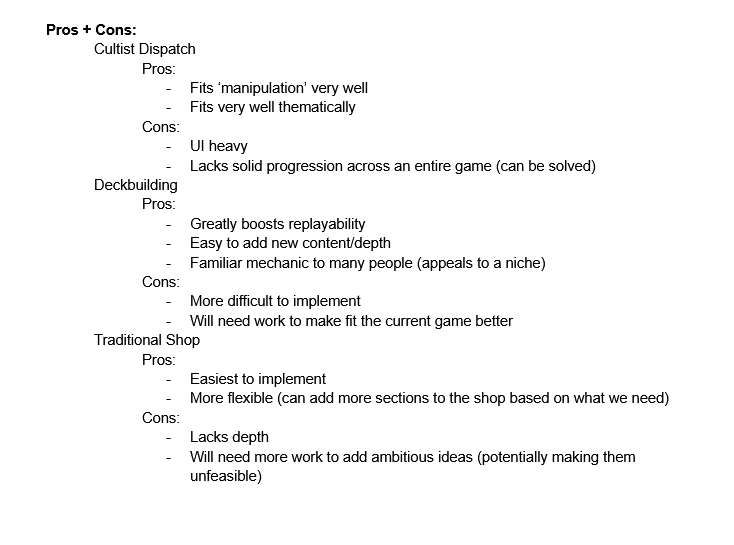
Eventually we landed on the idea of using your points to dispatch cultists to take care of tasks for you, whether that be in the real world, like gathering information on the humans, or in the maze itself, like building barriers or other objects.
Quite early on however we got playtest feedback that people weren’t really enjoying the capture minigame, as they felt that having a realtime minigame didn’t fit the strategy feel of the rest of the game. Based on this feedback we felt it would be better to build the functionality of gaining new cultists into the cultist dispatch system itself, creating new interesting decisions for players to make every turn, something that fit the overall gameplay a lot better.
At this point I created a spreadsheet to hold all the information about what options would be presented to the player, with four distinct categories:
- Fear generators (like the ability to give players hallucinations, build disturbing objects from their past, and more)
- Information (these provide the player with background information to help determine their fears, which is useful in dialogue)
- Map Manipulators (Like placing barriers or lures on the map)
- Economy Cards (focused on building your cult)
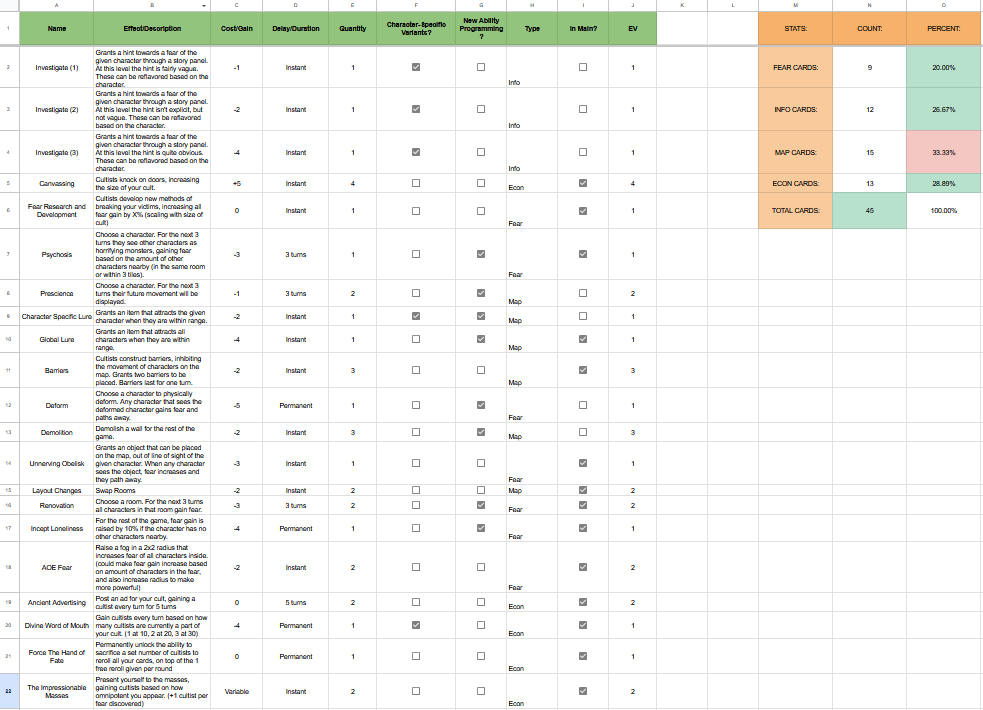
It was around this time that I built an early prototype of this system as well, pictured below.
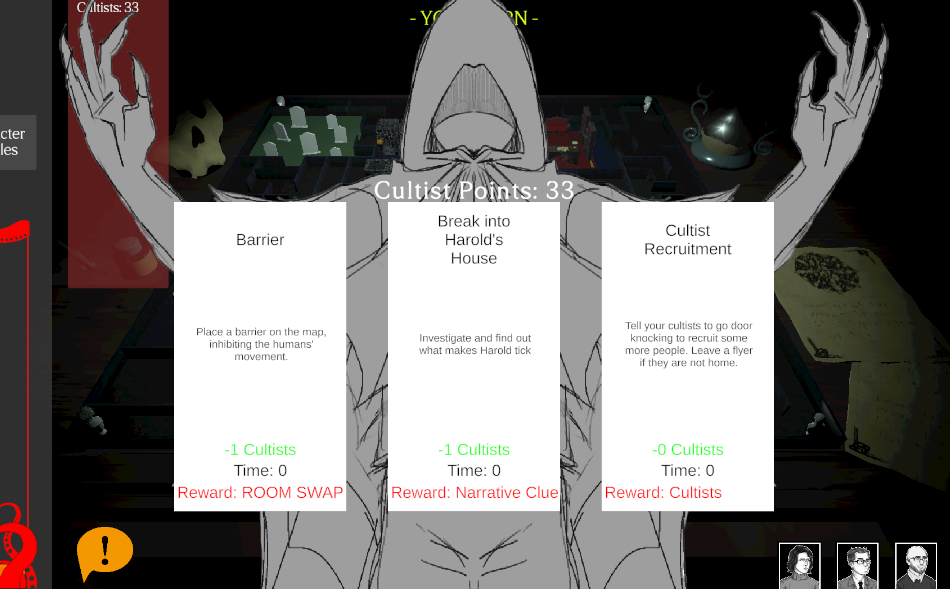
Based on this early prototype of the cultist dispatch we decided we wanted to move forward with it, and began assigning tasks; programmers to work on individual cards, and artists to work on the necessary UI art and VFX.
It’s at this point that I wanted to tackle the issue mentioned as a con for this system at it’s inception, the lack of game-wide progression. I began testing out some ideas, like having cards that upgrade as you select them multiple times, among other things.
Eventually during a feedback session somebody mentioned having abilities like the barrier or psychosis be permanent unlocks as opposed to one-time uses. After giving it some thought I realized this was probably the most elegant solution to our problem, as ability unlocks naturally gave the player more options later into the game, and therefore more power. Combining this with a per-use cost for each ability and giving the player abilities to snowball their cultists, we arrived at a satisfying solution to our progression problem.
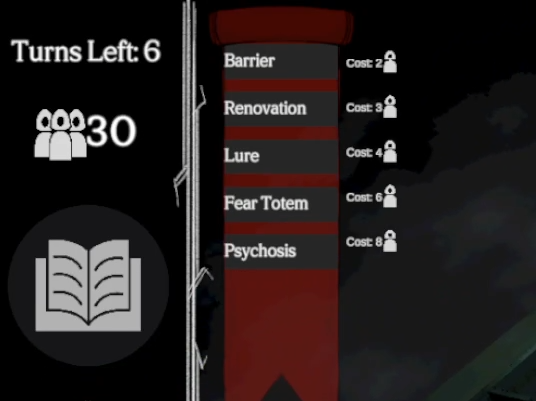
This system however now introduced a new (while at the same time being the oldest) issue, balancing. During our last sprint I was tasked with balancing the game. I split this task into two separate problems, balancing abilities, and macro-scale balancing.
To solve these problems I took a data-oriented approach to balance, building telemetry into our game to get an idea of what abilities were most used, how often people won or lost and in what ways, and how much value players were getting out of their ability uses.
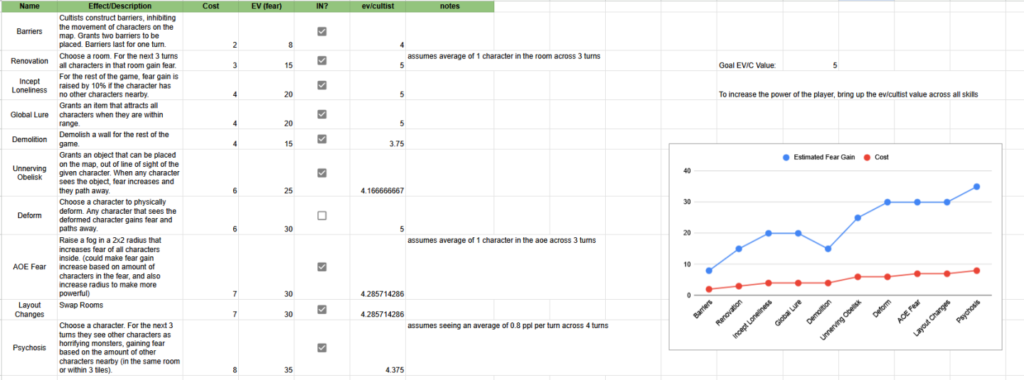
I then built another spreadsheet to map the estimated value (EV) of each ability to it’s per-use cost, allowing for easy viewing of outliers, and quick correction of said outliers.
Overall, Miskatonic has been a great opportunity to practice many areas of game design, experience that I’m excited to bring to future projects where I can hone my skills even further!